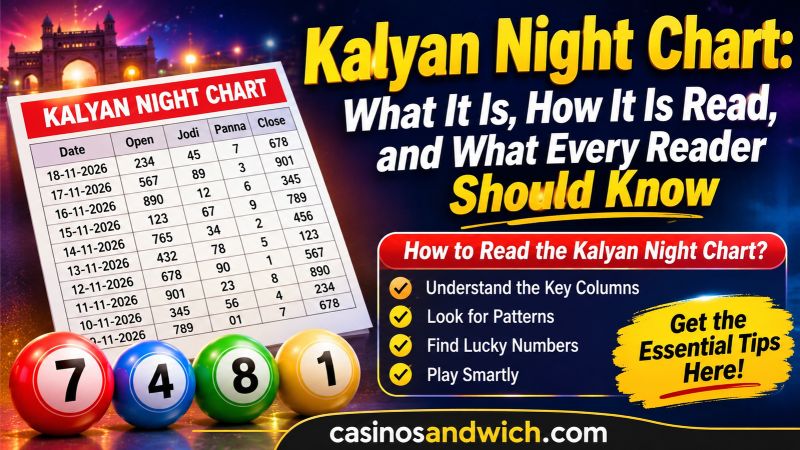
You have probably seen the phrase kalyan night chart on websites, in WhatsApp forwards or on the lips of someone at a tea stall, and wondered what the fuss is about. It refers to a record of numbers produced by one market of the satta matka game, which is a form of betting. This article explains where it came from, how the chart is laid out, why people get hooked, and where the law stands, so you can make an informed decision rather than a hopeful one.
Also Read: A Guide to Understanding VIP Satta 786 Betting
1. Where the game came from
Matka began long before smartphones. In the late 1950s, bets were placed on the opening and closing rates of cotton traded between New York and Bombay, with results relayed by telephone. When that was discontinued, bookies replaced it with a system that drew numbers out of an earthen pot, a matka, and the name stuck.
Kalyan Matka is described as one of the oldest and best known versions, started in 1962 by Ratan Khatri. Over the decades the business grew into several “markets,” each with its own name and schedule. Kalyan became one of the most talked-about, and its night variant is the one people check late in the evening.
In short, the chart you see online is the tail end of a game that has run on trust in an unlicensed operator for more than sixty years.
2. What “Kalyan” and “Night” mean here
- Kalyan is simply the name of the market. It isn’t a place you can visit or a lottery run by any government.
- Night indicates the later-in-the-day session, as opposed to day-time sessions run under other names. Different websites list slightly different timings, and none of them is official.
- Market is the label for a whole series of daily draws. Each market keeps its own history, and that history is what the chart displays.
Remember that nobody independent audits these draws. The numbers appear because an operator announces them.
3. What is a chart, exactly?
A chart is a table of past results. Think of a cricket scorecard archive, except that every row records a gambling outcome.
Typically it lists:
- Dates or weeks down the side.
- Days of the week across the top, usually Monday to Sunday.
- Result entries in each cell, a short string of digits for that day.
- Blank or holiday cells where no draw took place.
People scroll through years of these rows hoping to see a pattern. We will come back to why that doesn’t work.
4. The vocabulary on the page
If you open any matka chart, you will run into a handful of terms. Knowing them helps you understand what you are looking at, not how to win.
- Open and Close: The two parts of a daily result. One is announced first, the other later.
- Single digit (Ank): One digit, 0 to 9, derived from adding the digits of a three-digit group and keeping the last digit.
- Panna (Patti): A three-digit group.
- Jodi: A pair made from the open and close single digits.
- Market: The named game, such as Kalyan.
The system looks mathematical, and that is part of the appeal. It gives a feeling of logic around what is a random outcome controlled by someone else.
5. Why the chart attracts so many readers
It is worth being honest about the psychology, because it explains why smart people still lose money.
- The pattern illusion. Humans see streaks and cycles in random data. A chart is a perfect canvas for that.
- Low entry price. Bets can be tiny at first, so it feels harmless.
- Near-misses. Getting one digit right feels like almost winning, which pushes people to try again.
- Social proof. Everyone in the group talks about their one big win and stays silent about the twenty losses.
- Hope under pressure. For people with debts or unstable incomes, a fast payout looks like a way out.
None of these has anything to do with skill.
6. Can the chart actually predict anything?
No, and this is the most important point in the whole article.
- If the draw is honest, each result is independent. Yesterday’s number tells you nothing about today’s, just as a coin that landed heads three times is not “due” for tails.
- If the draw is not honest, the operator is choosing numbers and no pattern would help you either. In an unregulated game that is a real possibility, because there is no regulator, no audit and no complaint process.
- Selling “fixed” numbers is a well-known scam. Anyone who truly knew the result in advance would not be selling it for a small fee.
- Past performance on the chart is a record of what happened, not a map of what will.
Anyone promising guaranteed numbers is the one making the money.
7. The legal position in India
This is where readers most often get caught out.
- The central law is the Public Gambling Act of 1867, which prohibits running or being in charge of a public gambling house. The penalty written into that old statute is small by today’s standards, but states have amended and toughened it.
- The Act treats games of mere skill differently from games of chance. Matka is a pure chance game, so that exemption does not apply to it.
- Sources covering the topic describe matka as illegal across India, with no licence or legal route for either playing or organising it.
- Gambling is largely a state subject, and some states, including Maharashtra where the game began, have stricter laws.
- Some websites claim online matka sits in a legal grey area because the 1867 Act predates the internet. Treat that argument with caution. It is not a safe harbour, and the same coverage notes that unregulated online platforms leave players exposed to fraud.
- The Reserve Bank of India also restricts payment processing for gambling activity. That is one reason online matka operators rely on informal payment channels.
If you are not sure whether something is lawful where you live, assume the worst until a qualified lawyer tells you otherwise. This article isn’t legal advice.
8. Practical risks beyond the law
Even if you set legality aside, the game carries serious downsides.
- No recourse. If an operator refuses to pay, there is nobody to complain to.
- Rigged or delayed results. Unaudited draws can be manipulated and nobody can prove it.
- Fraudulent websites. Many chart pages exist only to collect traffic, sell tips or harvest phone numbers.
- Data and payment theft. Sharing UPI details or personal information with strangers invites misuse.
- Debt spirals. Losses prompt larger bets to recover them, which is the classic gambling trap.
- Family strain. Money secrecy and arguments are common long before any legal trouble arrives.
- Addiction. Coverage of satta games notes that many players develop gambling addictions that cause financial and personal distress.
9. Warning signs that a habit is turning into a problem
If any of these sound familiar, it is worth pausing.
- You check the chart several times a day without meaning to.
- You bet more than you planned, or more than you can afford.
- You borrow money, or hide how much you have spent.
- You feel anxious or irritable when you cannot check results.
- You chase losses by betting again immediately.
- You’ve missed work, bills or family commitments because of it.
- You have tried to stop and could not.
Gambling problems are common, treatable and nothing to be ashamed of. A doctor, counsellor or a trusted family member is a good first conversation. In India you can also reach the free Tele-MANAS mental health helpline on 14416.
10. Healthier things people turn to instead
If what draws you is the thrill, the numbers or the hope of extra income, there are alternatives that don’t put your savings at risk.
- Puzzle and logic games: Sudoku, chess and similar games give the pattern-finding buzz without the cost.
- Fantasy and quiz competitions where legal and skill-based: Check the rules in your state, and keep stakes you can afford to lose.
- Learning to read data properly: Basic statistics will teach you exactly why random sequences fool the eye.
- Small investments: Recurring deposits or index funds are slow and dull, but they are regulated and don’t depend on an operator’s word.
- Side income: Freelance work, tutoring or skills training can solve the money pressure that makes gambling tempting.
- A fixed entertainment budget: If you do spend on games, decide a limit in advance and treat it as the cost of the fun, not an investment.
11. How to spot a scam chart site
Many people land on these pages by searching for the latest numbers. A few quick checks will protect you.
- Pop-ups demanding your phone number or a payment before you can see anything.
- “100% sure” or “guaranteed” tips. No honest source can offer that.
- Several sites showing different results for the same date.
- No named owner, address or contact beyond a messaging app.
- Aggressive urgency, like countdowns and “last chance” offers.
- Requests to install an unknown app just to view a table.
When in doubt, close the tab.
12. Reading the chart as a curiosity, not a guide
Some people look at matka charts the way others read old railway timetables, out of interest in the history or the maths. That is harmless. If that’s you, keep these rules in mind:
- Treat the table as a record, not a prediction tool.
- Never send money based on anything you read there.
- Don’t share personal or payment details with a site that hosts one.
- Remember that the operators profit from your traffic whether you win or not.
Frequently asked questions
1. What does the Kalyan night chart show?
It is a historical table of results announced under the Kalyan night market of satta matka. Rows are weeks and columns are days. It records what was declared, nothing more.
2. Can I use the chart to predict the next result?
No. If the draw is genuinely random, past results tell you nothing about the next one. If it isn’t random, the operator controls the outcome and no chart can help. Anyone selling “sure” numbers is a scam risk.
3. Is Kalyan matka legal in India?
Generally no. The Public Gambling Act of 1867 and state laws leave no legal route for playing or organising matka. Online platforms often claim a grey area, but that isn’t a reliable defence. Laws vary by state, so ask a lawyer about your own situation.
4. Why do so many people still play?
Because of a mix of small starting bets, hope of quick money, near-miss excitement and the human habit of seeing patterns in random numbers. Stories of big wins circulate while the far more common losses stay private.
5. What should I do if I or someone I know can’t stop gambling?
Talk to someone you trust first, then consider a doctor or a counsellor. Limit access to money and betting apps, and delete tip groups. In India, the Tele-MANAS helpline (14416) offers free support. Recovery is very possible, and earlier is easier.
Final word
The kalyan night chart is really a story about numbers, hope and risk: a long history, a convincing format and no real way to predict what comes next. If you remember one thing, make it this. The table can tell you what happened, never what will happen, and the only reliable winner in the game is the person running it. If curiosity brought you here, you’ve now got the full picture, and if money worries or a habit are behind your searches, reaching out for support is a stronger move than checking one more result.
Tags: Kalyan Night Chart